Pure-TypeScript toolkit for working with music: name notes and chords, analyze harmony, recognize what you're hearing, voice and reharmonize progressions, and generate parts (bass, countermelody, drums, rhythm) — all with no runtime dependencies.
C4, transpose it, convert to/from MIDI, spell
intervals with correct enharmonics (F# vs Gb).V7/V), or lead-sheet symbols (Cmaj7, F#m7b5, C/G).The musical values — notes, chords, keys, progressions — come in two
interchangeable styles: a fluent, immutable class API (Note, Chord,
Key, Progression) that reads like music theory, and the underlying
tree-shakeable pure functions. Operations over collections and timelines
(part generation and whole-arrangement analysis) work on arrays of note events,
so — like rhythm, drums, and detectKey — they are exposed as functions.
yarn add @libraz/libcantus
The package root exports everything. To pull in a single layer, import its subpath instead:
import { Chord, Key, Note } from '@libraz/libcantus/model'; // class API
import { majorKey, makeChord } from '@libraz/libcantus/theory'; // scales, chords
import { generateDrums, generateProgression } from '@libraz/libcantus/generate';
import { analyzeArrangement, detectKey } from '@libraz/libcantus/analyze';
import { parseNote, edo } from '@libraz/libcantus/core'; // pitch, meter, tuning
The layers are core, theory, analyze, generate, and model.
The class API chains immutably and carries key context, so analysis needs no repetition:
import { Chord, Key, Note } from '@libraz/libcantus';
const c = Key.major('C');
c.chord(4, 'dom7').pitchClasses(); // [2, 5, 7, 11] (G7)
c.roman('V7/V').voice(); // [ ...SATB MIDI ] (secondary dominant, voiced)
Note.of('C4').transpose(7).name; // 'G4'
// A ii–V–I, built and analyzed in one line:
c.chord(1, 'min').progressionTo(c.chord(4, 'dom7'), c.chord(0, 'maj')).analyze();
// { chords: [...functional analysis...], cadence: 'authentic' }
Chord.detect([60, 64, 67])[0].quality; // 'maj'
Every class wraps a plain object (Chord.data, Note.data) and delegates to the
pure functions, so the two styles interoperate freely. The same task with the
functional API:
import { chordFromDegree, chordPitchClasses, classifyInterval, majorKey } from '@libraz/libcantus';
const cMajor = majorKey(0);
classifyInterval(7); // IntervalQuality.PerfectConsonance
chordPitchClasses(chordFromDegree(4, 'dom7', cMajor)); // [2, 5, 7, 11] (G7)
Parse and format notes, convert to MIDI, and spell intervals so enharmonics the pitch-class layer can't tell apart come out right:
import { Interval, Note } from '@libraz/libcantus';
Note.of('C4').transpose(7).name; // 'G4'
Note.of('C4').midi; // 60
Interval.between(Note.of('C4'), Note.of('F#4')).name; // 'A4' (augmented fourth)
Interval.between(Note.of('C4'), Note.of('Gb4')).name; // 'd5' (diminished fifth)
A KeyScale is a root pitch class plus a 12-bit modeMask12 (bit n set means
pitch class (rootPc + n) % 12 is in the scale). majorKey, minorKey, and
scaleByName cover the modes, pentatonics, blues, whole-tone, and octatonic
scales; MAJOR_MASK / NATURAL_MINOR_MASK let you define custom keys.
nearestScaleTone snaps a pitch to the closest in-scale MIDI pitch (preferring
the lower on a tie) — handy when constraining generated notes to a key.
From scale degrees, Roman numerals, or lead-sheet symbols — and back again:
import { Chord, Key } from '@libraz/libcantus';
const c = Key.major('C');
c.roman('V7/V').symbol(); // 'D7' (a secondary dominant)
c.chord(4, 'dom7').roman(); // 'V7'
Chord.parse('F#m7b5').pitchClasses(); // [0, 4, 6, 9]
Chord vocabulary spans triads through thirteenths — dim7, m7b5, minMaj7,
aug7, sixths, and altered dominants included.
Or generate a progression from a style preset (a collection-level operation, so it stays functional):
import { generateProgression, majorKey } from '@libraz/libcantus';
// One chord per bar, secondary dominants inserted where they fit:
generateProgression({ key: majorKey(0), style: 'idol', bars: 8, reharmonize: true, seed: 1 });
Turn chords into Roman-numeral analysis with function, cadences, and modal interchange — in major and minor, respecting inversions:
import { Chord, Key } from '@libraz/libcantus';
// A minor iv in a major key reads as a borrowed subdominant:
Chord.of('F', 'min').analyze(Key.major('C'));
// { function: 'subdominant', borrowed: true, source: 'parallel-minor', roman: 'iv' }
Notes in, chord or key out — the inverse of the builders:
import { Chord, detectKey } from '@libraz/libcantus';
Chord.detect([60, 64, 67])[0].symbol(); // 'C'
Chord.detectBest([60, 63, 67, 70])?.symbol(); // 'Cm7'
detectKey([0, 0, 0, 4, 7])[0]; // C major, best fit (key ranking stays functional)
A Key carries a spelled tonic, so the pitch-class core produces letter names,
correct in major and minor:
import { Chord, Key } from '@libraz/libcantus';
Key.named('harmonicMinor', 'A').noteNames(); // ['A', 'B', 'C', 'D', 'E', 'F', 'G#']
Key.minor('E').noteNames(); // ['E', 'F#', 'G', 'A', 'B', 'C', 'D']
// Chords spell in a key's context too:
Key.major('C').chord(4, 'dom7').spell().map((n) => n.name); // ['G', 'B', 'D', 'F']
Reflect a chord through negative harmony on the class, or list substitution candidates — tritone, relative, borrowed, and chromatic-mediant subs, plus modal-interchange palettes — with the functions:
import { Chord, Key, majorKey, parseChordSymbol, substituteChord } from '@libraz/libcantus';
Key.major('C').chord(4, 'dom7').negativeHarmony().symbol(); // 'Dm7b5'
// Substitution/palette search returns lists, so it stays functional:
substituteChord(parseChordSymbol('G7'), majorKey(0));
// [{ chord: Db7, type: 'tritone', ... }, ...]
Find scales compatible with a chord and its available tensions and avoid notes
on the class; get a continuity-optimized scale choice across a whole set of
changes with scalesForChanges:
import { Chord } from '@libraz/libcantus';
Chord.of('C', 'dom7').scales()[0]; // { name: 'mixolydian', rootPc: 0 }
Chord.of('C', 'maj7').tensions('ionian'); // [2, 9] (9 and 13; the 11 is an avoid note)
Realize a progression into smooth 4-voice (SATB) MIDI voicings with minimal motion, or voice a single chord in a comping style (drop-2/3, shell, rootless):
import { Chord, Key } from '@libraz/libcantus';
const c = Key.major('C');
// A whole progression, voiced with minimal motion:
c.chord(0, 'maj').progressionTo(c.chord(5, 'maj'), c.chord(4, 'dom7'), c.chord(0, 'maj')).voice();
// [[...], [...], [...], [...]] (one ascending pitch per voice)
// A single chord in a shell comping voicing:
Chord.of('C', 'maj7').styledVoicing({ style: 'shell' }); // root, third, seventh
voiceLeadingCost and nextVoicing let you steer the leading, and the
counterpoint predicates (parallel/hidden perfects, spacing, voice crossing,
leading-tone resolution, …) let you validate it.
Seeded, deterministic generators for melody and accompaniment:
import {
generateBassLine, generateCounterMelody, generateDrums, generateRhythm,
generateMotif, majorKey, parseTimeSignature,
} from '@libraz/libcantus';
generateRhythm(parseTimeSignature('4/4'), { seed: 1, density: 0.5 }); // strong-beat-weighted onsets
const motif = generateMotif({ key: majorKey(0), bars: 2, contour: 'arch', seed: 1 });
motif.notes.length > 0; // true — a deterministic short melodic cell
humanize, extractGrooveTemplate, and applyGrooveTemplate add a meter-aware
feel — or capture the feel of one performance and transplant it onto another.
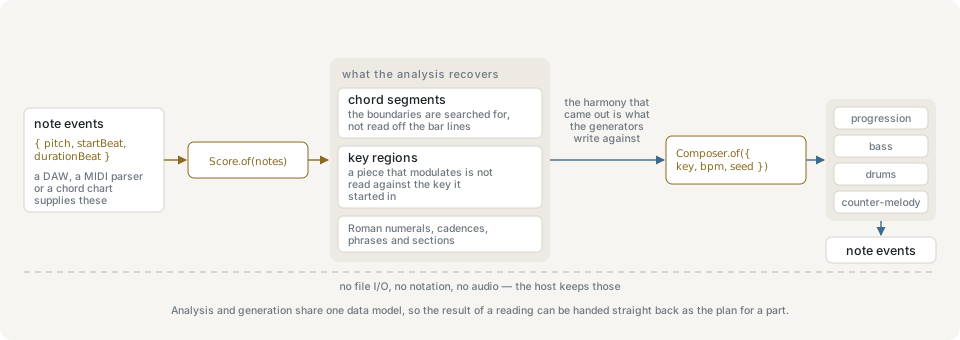
The arrangement layer takes raw multi-track NoteEvents, recovers the harmony,
then analyses and generates against it:
import {
analyzeArrangement, chordTimelineFromNotes, generateBassLine, generateCounterMelody,
} from '@libraz/libcantus';
// Infer a chord progression (and the key) from played notes:
const { timeline, key } = chordTimelineFromNotes(melodyAndChordNotes);
// Whole-piece analysis: inferred chords, cadences, per-note theory labels, and
// notes that clash with the sounding harmony (with reasons and suggestions):
const report = analyzeArrangement([
{ role: 'melody', notes: melodyNotes },
{ role: 'harmony', notes: chordNotes },
]);
report.conflicts; // [{ beat, trackName, pitch, safety, reasons, rationale }, ...]
// Generate the missing parts from the recovered timeline:
generateBassLine({ segments: timeline.segments, key, style: 'walking', seed: 1 });
generateCounterMelody({ melody: melodyNotes, chordAt: timeline.at, key, register: 'below' });
harmonizeMelody goes the other way — given a bare melody, it searches for the
best key, transpose, and chord path (with optional reharmonization) to harmonize
it.
Note events shared across the arrangement and generation modules use one type,
NoteEvent ({ pitch, startBeat, durationBeat, velocity? }, MIDI pitch in
quarter-note beats). Seeded generators (bass, groove, countermelody,
rhythm, drums, motif, progression) are deterministic for a given seed.
Frequencies, cents, EDO, and just intonation — for tuning, microtonality, and analysis:
import { frequencyOf, edo, justDeviationCents } from '@libraz/libcantus';
Meter helpers (TimeSignature, parseTimeSignature, beatsPerBar,
metricWeight, isStrongBeat, tuplet) cover simple and compound meters and
back the accent-aware generators.
Full API reference — every export with signatures, categorized by domain and with runnable examples — is generated from the source and published at libraz.github.io/libcantus.
Apache-2.0